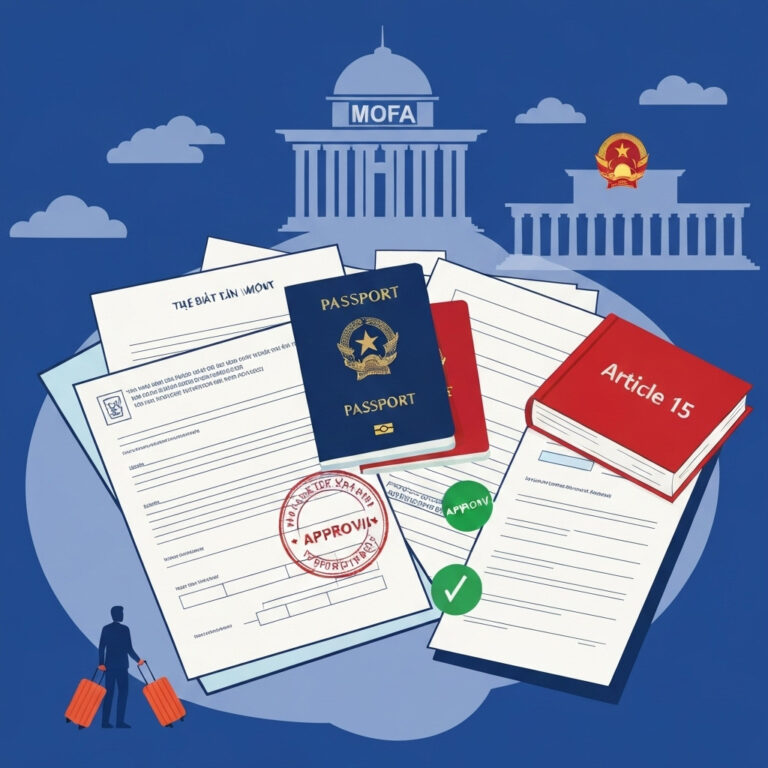
Article 26 of the Law on Exit and Entry of Vietnamese Citizens regulates how citizens can use ordinary passports and international travel documents when traveling abroad. These documents are the foundation for proving identity and citizenship, ensuring smooth immigration procedures at border checkpoints.
✅ Key Points of Article 26
Ordinary Passports
Used by Vietnamese citizens for general travel, business, study, tourism, or visiting relatives abroad.
Must remain valid and undamaged to be accepted by foreign authorities.
International Travel Documents
Issued under treaties between Vietnam and bordering countries.
Typically used for cross-border movement in special agreements, such as with Laos, Cambodia, or China.
Legal Obligations
Citizens must use their passports and travel documents strictly in accordance with the law.
Passports may not be altered, lent, or misused.
Any loss or damage must be reported immediately to the competent authority.
🌏 Vietnam Entry Visa – Supporting Your Legal Travel Needs
Understanding Article 26 helps citizens avoid violations while traveling. At the same time, foreigners visiting Vietnam also require valid entry documents.
👉 Vietnam Entry Visa provides:
Fast-track e-Visa processing (1–2 working days).
Visa on arrival and urgent visa services at Vietnam’s international airports.
Visa extension and renewal support for long-term stays.
24/7 English customer service for travelers needing quick answers.
Whether you are a Vietnamese citizen ensuring proper use of passports or a foreign visitor applying for a visa, Vietnam Entry Visa ensures your journey remains legal, safe, and stress-free.
Check Visa Requirements
Estimated Total Cost: $0.00 Includes Vietnam government eVisa fee and service assistance fee
To be issued a Vietnam visa, foreigners must (1) hold a valid passport/travel document, (2) not fall under any suspension-from-entry grounds (Article 21), and (3) have a Vietnam-based inviter/guarantor unless exempt (e.g., e-Visa under Clause 3, Article 17). Additional purpose-specific documents are required for investment, work, study, legal practice, etc. Who this helps (and the…
According to Vietnam’s Immigration Law, a passport is a legal travel document and proof of citizenship. However, in certain cases where a person’s citizenship status changes, their passport will be revoked or invalidated by the competent authority. 📌 Cases Where Passports Are Revoked or Invalidated A Vietnamese passport may be revoked or invalidated if the…
Article 9 sets the maximum validity for each Vietnam visa symbol. Short trips (SQ, HN, DL) run up to 30–90 days; VR allows up to 6 months; many official/study/business/family categories run up to 12 months; LĐ (work) runs up to 2 years; ĐT (investor) runs up to 5 years. Your visa’s validity must also be…
For diplomatic/official categories (NG1, NG2, NG3, NG4) under Article 8, Vietnamese agencies/organizations must file invitations/guarantees through the Ministry of Foreign Affairs (MOFA). MOFA coordinates with the Immigration Management Agency and instructs overseas Vietnamese missions (embassies/consulates) to issue visas or authorizes border-gate visas when conditions are met. Who this is for (and typical questions) Government bodies,…
On June 24, 2023, Vietnam’s National Assembly passed important amendments to the Law on Entry, Exit, Transit, and Residence of Foreigners. These changes, effective from August 15, 2023, impact how foreigners apply for visas, declare residence, and stay in Vietnam. This article summarizes the most relevant updates from Article 2 of the law in a…
Article 51 establishes the effective date of the Law on Exit and Entry of Vietnamese Citizens. This law officially came into force after being passed by the National Assembly, setting the legal foundation for the management of passports, immigration documents, and the rights and obligations of Vietnamese citizens when traveling abroad or returning home. ✅…