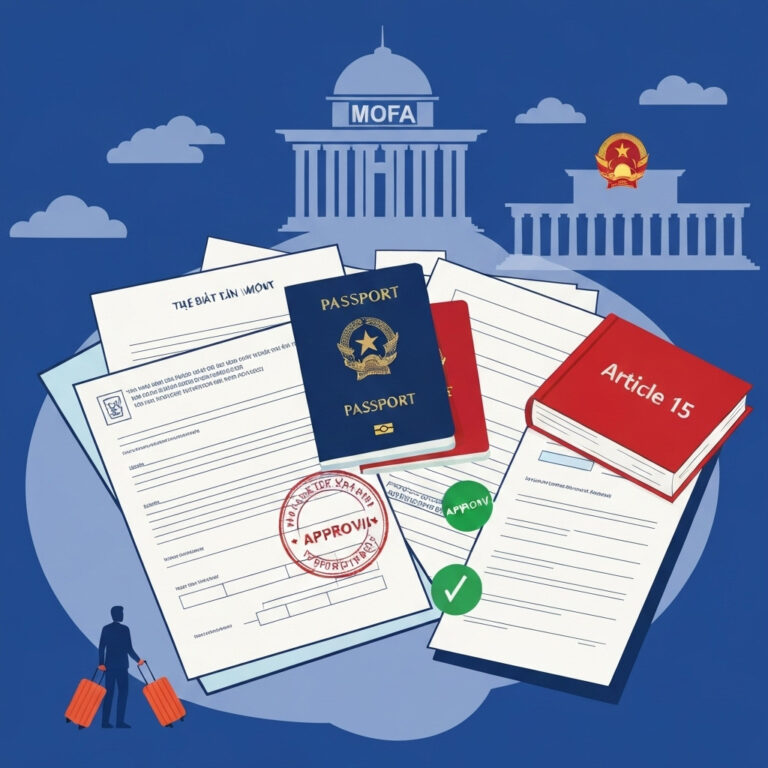
Under the Law on Exit and Entry of Vietnamese Citizens, the Government Cipher Committee plays a crucial role in ensuring the security and management of immigration papers, especially passports with electronic chips.
✅ Responsibilities of the Government Cipher Committee
The Committee is tasked with:
Providing official digital signature authentication services for the issuance and management of passports containing electronic chips.
Ensuring data security and protecting sensitive information stored in passports.
Guiding ministries and related agencies in applying digital authentication to manage passports effectively.
Cooperating with the Ministry of Public Security and Ministry of Foreign Affairs in strengthening cybersecurity and safeguarding national interests in immigration processes.
By managing encryption and authentication, the Government Cipher Committee guarantees that Vietnam’s immigration system is both secure and internationally recognized.
🌏 Support from Vietnam Entry Visa
While the Government Cipher Committee ensures national-level passport security, travelers also need reliable visa support when planning to enter Vietnam.
On June 24, 2023, Vietnam’s National Assembly passed important amendments to the Law on Entry, Exit, Transit, and Residence of Foreigners. These changes, effective from August 15, 2023, impact how foreigners apply for visas, declare residence, and stay in Vietnam. This article summarizes the most relevant updates from Article 2 of the law in a…
On June 24, 2023, Vietnam’s National Assembly approved significant amendments to the Law on Entry and Exit of Vietnamese Citizens. These changes, effective from August 15, 2023, modernize passport issuance, strengthen management of lost or unclaimed passports, and promote digital transformation in immigration services. This article summarizes Article 1 of the amendments in an easy-to-understand…
Under Vietnam’s Immigration Law, visas can be issued not only at border gates or overseas embassies but also directly at the Immigration Management Agency or at the competent agency of the Ministry of Foreign Affairs (MOFA). This provides flexibility for foreigners who need to enter Vietnam for tourism, business, work, or other permitted purposes. 📌…
Article 26 of the Law on Exit and Entry of Vietnamese Citizens regulates how citizens can use ordinary passports and international travel documents when traveling abroad. These documents are the foundation for proving identity and citizenship, ensuring smooth immigration procedures at border checkpoints. ✅ Key Points of Article 26 Ordinary Passports Used by Vietnamese citizens…
Article 5 lists what is not allowed in Vietnam’s immigration system: obstructing lawful rights/obligations, creating unlawful procedures/fees or harassment, illegal entry/exit/residence, false information or forged documents, activities against national security or public order, and misuse/transfer/alteration of immigration papers. Who this helps: tourists, business travelers, expats/students, employers, hotels/landlords, tour operators, and compliance teams who need a…
For diplomatic/official categories (NG1, NG2, NG3, NG4) under Article 8, Vietnamese agencies/organizations must file invitations/guarantees through the Ministry of Foreign Affairs (MOFA). MOFA coordinates with the Immigration Management Agency and instructs overseas Vietnamese missions (embassies/consulates) to issue visas or authorizes border-gate visas when conditions are met. Who this is for (and typical questions) Government bodies,…